Saturday, May 7, 2022

The Texas Rattler Treble Booster.

One effect I never fully understood was the treble booster. I knew Brian May and Stevie Ray Vaughan used them but I didn't know a myriad of other guitarists such as Tony Iommi and Warren Haynes use them as well. After watching Warren Haynes' rig rundown (again) I took notice of the Cesar Diaz built Texas Ranger he had hidden away in his effects rack. After a few days of pondering I figured I may as well throw one more project on the to do list. Luckily for me treble boosters are fairly simple to build, and it seemed as though I already had everything I needed to build one. I originally wanted to build a Diaz Texas Ranger clone, but I didn't have a rotary switch for the selectable input cap feature so I decided to start looking for something else.

The most popular option seemed to be Catalinbread's Naga Viper, so I found the layout on tagboard effects (where I get almost all of the layouts for my builds) and started my journey. The Naga Viper has an additional gain and tone control (called heat and range respectively) along with the boost control, which sounded like features I would never actually use, but I built the pedal with these features just to rule them in or out. I didn't want to build a straight clone of the Naga Viper so I took a few liberties such as socketing the transistor to see which of the ones I had sounded the best, finally settling on a BC548. I also put in a toggle switch to switch between a 5nf and a 100nf input capacitor, mimicking the highest and lowest options of the Diaz Texas Ranger, which I later removed because I felt it really just muddied everything up, leaving the 5nf in as the main input cap.

After a week or so of testing I decided to remove the tone control, but without it or the input capacitor switch I felt the build was now missing a way to thicken it up. Even though I didn't like the tone control there was none of the mud that the input cap switch seemed to introduce, but it did give it a thicker, somewhat fuzzy edge that I kind of liked. In place of the potentiometer I used a toggle switch to close or open the place where the potentiometer once was, which gave me both extremes of the tone control's range. This suited me perfectly. Once all was said and done I decided to keep the gain control as it turned out to be quite useful in taming some of the girth when the tone switch is in the thickest position.

I normally question how closely all my other builds sound to the originals they were inspired by, but since this build was inspired by both the Diaz Texas Ranger and the Naga Viper, plus I did some slight mods, I'm not sure how it would compare. Since it only has a few components it could either sound very similar or not at all, but either way I'm fairly happy with how it turned out. I've named this build the Texas Rattler, borrowing from the Texas Ranger and the viper part of Naga Viper. The controls are Hiss (boost), Heat (gain) and Humidity (Low/High tone switch). This build has not only inspired confidence to explore ways to adjust a build to my needs, but also I like to think I've learned more about what a treble booster does and why some of the greats have used them throughout their careers. I swear I didn't want to build this many guitar pedals in 2022, but I'm glad I chose to build this one.

Wednesday, April 27, 2022

Pedal Redemption and Progressing Forward

As I said before sometimes you can't win them all, but that doesn't mean you should cease persevering. The initial results of my Runoff Groove Umble clone (I've dubbed the Humble) were nowhere near what I had hoped for. Since biasing JFETs was new to me I wasn't shocked, I was just disappointed. Things looked bleak at first, I was lost and confused about how I was ever going to make it work. I knew I had come this far and I wasn't about to let it go under any circumstance. Sure, I'm an idiot and I made mistakes but I decided to sit down and try to fix it the best I could. I think I've learned a lot along the way and the end results are far better than where I was before. I've learned to never give up on something you're passionate about, and keep trying to do the right thing and make it better. Eventually you'll get there.

Truly Humbled by this build, but the results are worth it.

This redemption spurred on my desire to fix up a few of my older builds that had some minor issues. Both my LPB-1 and Boss OD-1 clones had wandering transistors that needed to be addressed. Initially I used sockets to test which transistor(s) sounded best in those pedal builds, but once the pedals were enclosed in their aluminum homes I noticed they didn't always want to work. While investigating the situation I found the transistors had wandered loose and needed pushed back into their socket to make the pedal work again. Instead of removing the sockets I decided just tacking one leg of the transistor onto the socket would keep it from wandering out of place. Voila! Job done.

Technically all the pedals I've built are functional, but some do have issues that require more involved troubleshooting than even the Humble pedal did. My initial feelings when I test a new build are a mixture of hope and the understanding that there might be an issue, so I need to try and troubleshoot with a clear mind if it doesn't work the first try. Sometimes I've had to rebuild the board all over again, sometimes I've wanted to throw the whole project into a woodchipper, promptly followed by myself, but that doesn't solve the problem. I just take a breath or two, sit back down and make sure it's wired correctly, then go over some basics that I know I can solve right away.

As for progress forward, well that's a bit of a dicey situation. I originally planned 2022 as a relaxed year where I would only build half a dozen pedals that I really need to build and spend the summer actually using them to create some music. That, however, is not exactly how things are shaping up. My original to build list consisted of the LandTone Centaur clone, my Blues Master (Bluesbreaker clone), my Rata Blanca (Rat clone), an EQD Disaster Transport Jr. delay clone, a Rub-a-dub Reverb Deluxe clone and another pedal I'm not going to discuss yet, as it will get its own post once it's done. Since four of the six pedals I planned to build came together so quickly I figure I could add more pedals to my list. So far I've added two pedals to the list, one of which I'm planning to mix two pedals together to make one.

One of the newly added pedals has already been built. I wasn't sure at first whether I wanted to build it, but because it really didn't need that many parts I figured I may as well. Thus, the Shoe Pedals Pixel clone was born. I'm not a big fan of fuzz, but I am a big fan of vintage video games and this pedal brings them both together. It took me a little while to get that 8-bit sound dialed in, but when I did I was very impressed. Not only that but it actually has a very useful fuzz hidden in there, which is kind of changing the way I feel about fuzz as an affect.

Part of the Class of 2022: Blues Master, Rata Blanca and Disaster Delay.

I still have a few projects to start and I'll get to them when the time is right. I have some ideas where I'm going to try modifying and mixing together a few pedals to build a kind of unique design of my own making, and a few other pedals I want to take the time and get them done right. Trust me, regardless of how those plans work out I'll be posting the results here as either tales of success or yet another cautionary tale of my failure. I guess we'll just have to wait and see how it all goes. Wish me luck!

Tuesday, April 12, 2022

Creature Comforts

There are many things in this world beyond our control, but somehow most people tend to be able to cope.
Everyone has their own thing(s) that put them at ease, whether it be a thought, or maybe a physical item.

At a younger age I used video games to calm myself, when the world at large just felt too overwhelming.
My world, at least back then, wasn't too stressful. After all I was a kid and really didn't have much reason.
Over the past few years, as I grow older, things have started to become more and more uncomfortable to me.

Perhaps it's just what happens as one starts to age and the veil of adolescence finally starts to wear off.
All I know is that I'm feeling increasingly stressed the older I get. Time really does fly when you're a certain age.
Optimism has never been my strong suit, but I feel the older I get the more I need to try and harness or use it.
Lately I've been thinking more about my future, but even more so about the past, when I was much happier.
At my age I guess that's just the natural trajectory of the mental gearing. Thinking back to brighter days.

In my mid-20s I used movies, specifically Me, Myself & Irene as well as Clerks 2 to calm myself through stressful days. There is one scene in Me, Myself & Irene where Jim Carrey and Renee Zellweger are walking down a country road, which reminds me very much of the country road I grew up on. I guess something about that road unlocks something in my mind and transports me back to being a kid. Back then all I had to do was wake up, hop on my bike and be back home before dark, but even so my childhood years aren't the best years of my life.

When it comes to Clerks 2, I feel it has a bit more to do with the fear of growing up. The fear of what changes growing up not only offers but sometimes even mandates. No matter how young we are in our own minds, we're slowly but surely leaving behind the comforts of our younger selves. In many ways that's good, but there always seems to be that nagging feeling that you're going down the wrong path and you long to stop being a grownup and return to the simpler times. Clerks 2 came about in my life at the perfect time, where I felt I could connect with the characters and feel their strife. This is about when my life started to actually mean something.

These days I'm finding it harder and harder to find anything that helps me settle down. I had it, I had someone who could calm me down quicker than anything else ever could, but she was lost along life's separation path a few years ago. I've tried the old movies, I've tried new movies, I've tried music, I've tried building guitar pedals, I've tried video games, but something is still missing. A large part of me, who I feel I should be, who I should be with and where I feel I should be are now just missing pieces, leaving even more doubt and anxiety. These were the definitive years of my life, these were the best years of my life. I love that time in my life, it's a massive part of me. I deeply miss that part of me. I just hope, wherever she is now, she knows that and will always remember that.

"You're here with me, it's going to be ok." - My Missing Piece

Friday, April 8, 2022

There's Something About Centaur

After I refurbished Kali, my Kalamazoo Model 1, I started feeling the need to expand my effects pedal collection, which at that point was merely two pedals and a Zoom 506. Eventually the DIYer in me decided it would be more fun to just build clones of the pedals I've always wanted on my own. Once one pedal was done I would often research for hours on end, trying to find out which pedal I wanted to build next. It has to be said that no other pedal has taken up more of my research time than the legendary Klon Centaur.

Admittedly I was completely unaware of this pedal's existence until after I started building pedals. The more I researched the Centaur the more intrigued I became with it. One man's quest to replicate the way guitar amps sound when they have reached harmonic perfection, while doing so at any volume, at any venue. After years of testing and help from engineers the Centaur was born, all according to legend. Although I'm nowhere near that level of pedal builder, still I connected deeply with the one-person operation aspect.

I will most likely never even see a real Klon Centaur pedal, let alone own one, so my DIY pedal builder instincts kicked in. I started researching what would be the most accurate Centaur clone that I could build for myself. One option that kept coming up was the LandTone clone, often purchased from Wish.com preassembled and ready to go. I watched as many comparisons as I could find of this pedal beside either a real Centaur or highly accurate clones. Even through youtube I could tell the inexpensive little pedal wasn't a 100% accurate recreation, but it did sound fairly close to what the comparison pedal was doing. So close that I decided to purchase the pedal kit from Amazon and build one for myself.


I've gone over my building of the clone kit before, so I won't bother with that here, but I have to say I've become enamored with what the little pedal does. From clean boost, treble boost to an overdrive that is super dynamic depending on your pick attack. This pedal really seems to offer a lot in one pedal, and that's just the clone pedal I've built. I can only imagine what a real Centaur would offer, which I feel would have to be better to some degree.

For the longest time I felt the tube screamer was the cream of the crop, and while I still love the TS808 clone I built, I think this Centaur clone kit just opened a completely new door. There is just something about the Centaur that I really connect with tonally. The blend feature, I think, is really where the magic is, allowing this pedal to go from clean boost to all out overdrive, with the aforementioned other features allowed to dwell within that spectrum. Of course I'll still use my TS808, Boss OD-1, DOD 250 and whatever other drive clones I've built when they're needed, but I have to keep saying there is just something about the Centaur that sets it apart in a great way.

Sunday, March 20, 2022

Well, You Can't Win Them All!

Sometimes life slaps us in the face just to see if we're still paying attention. One such instance for myself was the other day when I was trying to put the finishing touches on what I felt was my most ambitious guitar pedal build yet. This pedal was meant to be my foray into JFETs, but it didn't go as planned. I was already anxious about the project because I finished the circuit board back in October of 2021, but I didn't have the JFETs or the enclosure to put it into until more recently.

The project in question is a RunOff Groove Umble. I was instantly intrigued by how good this pedal sounded in the demos I found online. The build seemed simple enough, but I was nervous about the need to manually bias the JFETs. To compound my anxiety about this build I used perfboard instead of stripboard, as I was running low on stripboard. I had made a few pedals using the perfboard and they turned out alright, so I figured I may as well, right? HA!

It will look pretty cool once it's done though, right?

I originally planned on this to be the first pedal I finished for the 2022 season, but instead I built two other pedals. Even though all this project needed was wired up and the JFETs biased, I was still putting it off until I felt I couldn't put it off anymore. Wiring didn't take as long as I had feared, which was nice, because I really do hate wiring guitar pedals. With everything setup it was time to put the board into the housing, bias the drains and bask in the glory of finally having built what I consider to be my most complex build so far. That's when things took their turn.

I cautiously plugged the pedal in, as I always expect something to blow up the first time I plug in one of my builds. Can you guess what happened next? Well, nothing exploded, so that was a plus. I was relieved to find that 9 volts was flowing into the pedal as it should and nothing was smoking, smoldering or exploded. Time to bias the drains. Right? Nope, what I had worried about the most became the issue I wished it wouldn't have.

I think my first problem was the layout I used calls for 100k, but I used 10k because that's all I had at the time, but that simply didn't work whatsoever. In an attempted Hail Mary I removed the 10ks and installed proper 100ks. Can you guess what happened next? Nine volts goes into the pedal, the 100k biasing pots turned all the way down only brought it down to 8.5 volts. Yep, something's fucky!

Handwriting FaIL too.

It was at this point I decided to activate Plan B, which was to cut a completely new board out of stripboard and attempt to build this pedal all over again. I've had to tear down pedals and rebuild them from scratch a few times, but I really didn't want to have to build this pedal more than once. For over an hour I sat there harvesting all the parts off the perfboard failure and testing them to make sure they were still within spec and could be reused for the rebuild. Everything checked out good enough, so I just bagged them up and decided to wait a few days before giving this project another try.

After a few days of rain the sun finally came back out, so I decided it was now or never. I rebuilt the whole pedal and set everything up to bias the JFETs. Well, it turns out I am an idiot and didn't know the JFETs need to be in place to be biased. See, I assumed I could bias the sockets I installed to accept the JFETs prior to putting them into place. NOPE! That's not how that works. Lesson learned, we're moving on. The reason I used sockets is because I had to build my own J201s from the surface mount size and convert them to through-hole. Also this gives me the option to change what's in there right now for TO-92 version J201s in the future.

While testing the pedal it sounds very thin and weak until the volume was cranked all the way up, but then it started screaming because it was cranked all the way up. I've had the screaming issue with a few other pedals and I'll figure out a fix for this someday, just not today. The EQ section seems to work, it's just the bias is still off, even at the suggested 4.5v. I guess those are rookie numbers and I'm going to have to pump those numbers up. For now the pedal is what I would consider finished, even though it still needs some tweaks, which will hopefully bring it around to working properly. I have dubbed this pedal the Humble as this pedal has well and truly humbled me.


Update: 12, April 2022

After sitting on this pedal for a while I finally decided to tinker with the biasing and was able, rather quickly, to figure out which JFET was the offending party. To be honest all of the JFETs needed a little voltage adjustment, but I blame myself in building the adapters to make them through hole from SMD. I still want to track down genuine TO-92 formfacter J201s, but for now it's functioning. I'm not exactly sure this is how it should sound, but I managed to dial in a much better effect than it was the day I put it in the enclosure. Now that I'm confident with biasing JFETs I will continue to tweak this pedal and I may even attempt more JFET based projects.

Tuesday, March 15, 2022

Pedal Building: The Centaur Clone

My guitar pedal building season 2022 started Monday March the 14th. It was a blustery day and the shade of the back deck made it almost unbearable, but I knew I had to get started sometime. My first pedal build was the Klon Centaur clone kit that I had just gotten a few days prior. I put this one ahead of my other builds as I felt time was important. Should there be any parts missing or issues arise with this pedal I would need to contact the seller as soon as possible. At present everything seems to be fine, for the most part.

My workspace on the back deck.

I started off as I always do; lowest components first and work upwards from there. I tested one of each component to make sure they were all labelled correctly. Can't be too careful! Everything was well marked on the main board, with the exception of one of the 100k resistors and the 821pf capacitor being a bit off, but I knew where they went after everything else was soldered up and they were the only parts left and their slightly misaligned places were left empty.

Stage 1

Stage 2

Stage 3

Once the main board was populated it was time to put everything into the housing and do some wiring. Wiring has to be my least favorite part of pedal building, but it has to be done. My distain for wiring was compounded by the fact the provided instructions are extremely vague on what wire goes where. I've wired up enough pedals to know how to wire up the input, output and DC jacks, but where on the board they go is the main mystery here. After doing some research I felt I had a good enough grasp on what went where and I went to work soldering it all up.

Stage 4

The problem is, I was wrong. Even after watching a few videos of people building it from start to finish and reading through some tutorials I still managed to get the output jack wired wrong. Once that was all squared away I had built a really nice pedal. Now, the elephant in the room is that this is a clone of an extremely well known and exceedingly sought after pedal that costs more than a decent used vehicle. That's exactly why I decided this was a project I was more than willing to tackle. I'll never own a real Centaur and even if this pedal doesn't replicate the tone exactly, what this pedal does still sounds pretty good to me. That means it's time for me to start my next project. Stay tuned!


Thursday, February 24, 2022

Pedal Building and 2022's Plans

What started out as a long time desire has grown into twenty confirmed builds. On January 2nd 2020 I put together my very first Bazz Fuss circuit. If you want to get technical about it I did build a footswitch for my Fender Mustang Mini a few years prior, but I don't consider that to be a true pedal build. My main focus was using/reusing parts I already owned or could harvest from electronics nobody wanted. From there I built a handful of other Bazz Fuss circuits, none of which count toward the twenty builds mentioned above. These builds were simply built to play around with values and component types to see how much of a difference it would make in the sound of the circuit.

Fast forward a few months when I noticed my Bazz Fuss pedal was now just boosting the signal, instead of being a fuzz pedal. Somehow I had destroyed the diode and the circuit became a super simple boost pedal. This is where things started to ramp up. Had I stopped at a handful of Bazz Fuss circuits I may have literally just stopped, but I began to research an easy to build boost pedal. Thus, the LPB-1 clones were made. A few weeks later I was given the chance to take apart an old radio my Dad had in the garage and found an NEC 4558 op-amp, and from that my TS808 clone was born. The wheels kept on turning and my Grey DOD 250 clone was born. Soon I felt that since I had built a DOD 250, I had to also build an MXR Distortion Plus, so at the beginning of the 2021 build season that's exactly what I did, but that was only the beginning.

2021 was the most active building year. From my Marshall Guv'nor clone, to many various DOD 250/MXR Distortion Plus clones, such as the Morley MOD-D1B, all the way to a R.O.G. Mockman build I was very busy last year. As 2021 came to a close I had built thirteen pedals with one more left at about 75% complete. It's my most complex pedal build and I hope to complete it as the first pedal completed for 2022.

And here we are in 2022 with a whole new season to build, but also a new year to enjoy the pedals I've built over the past two years. Some pedals have blown me away with how amazing they sound, while a few others continue to baffle me with varying issues. Although the perfectly working pedals heavily outweigh the pedals that exhibit some issues, I still have to troubleshoot the pedals that aren't exactly right. It's a process that I'm greatly enjoying and I'm hoping it leads to something bigger. This year has seven pedals in the planning stage, but it may also turn out to be a transition period for me as I plan to build my first pedal from a kit. I just want to see if I like building kits as much as I do building from scratch. 

Who knows, maybe if I purchase pedal kits and upgrade some of the components in them I might be able to turn this into a viable business of sorts. While I don't foresee that actually coming true, the plan is on the table. We'll just have to see where 2022 leads and what ups and downs I'll have to contend with. Maybe things will work out too well and I'll build more pedals this year than I did in the previous two years combined. For now I'm not sure what will happen beyond 2022, but I do know that I don't plan to build as many pedals, at least for now. However I will always be up for building a pedal here and there just to keep boredom away, or if something really interesting I want to build crosses my path.

Friday, December 31, 2021

My Review of 2021

The past few years have really been hell for us all, well most of us anyway. Due to personal reasons my hell began toward the end of October 2019. I took that as a reason to seek betterment of myself. With the world screeching to a halt a few months later I went one step further and decided this was a time in my life I couldn't pass up the chance to get a few things checked off the old bucket list. It was time to stop pushing the pause button on life and let it playout the way it would playout.

In 2020 I began an adventure in building guitar pedals, as well as selling off things I didn't need anymore to fund a future endeavor. Things went smoothly, given the circumstance, and as Autumn 2020 rolled in I felt it was time to relax and hopefully this whole pandemic would blow over so I could plan my next steps. As we all know that didn't go to plan, so in Spring 2021 I was actually quite antsy to build more guitar pedals, so I did.

I knew there were a few I wanted to build, like my MXR Distortion Plus clone, but I didn't have the drive to build it until the weather felt right to sit out on the back deck and get things done. After a few pedals I felt burnt out and took a break, but as the summer came that urge was put into overdrive (pun absolutely intended!) and more pedals were built. With a few successes and a few absolute failures, and complete rebuilds, the pedal ideas kept coming. For the pedal building season of 2021 I built thirteen pedals; substantially more than I did in 2020. Even as Autumn 2021 came around I was still planning, sourcing parts for, and cutting boards for pedals I plan to build in 2022. I think this year was the year pedal building became a bit more than just a hobby, and perhaps it has reached personal challenge status in my mind.

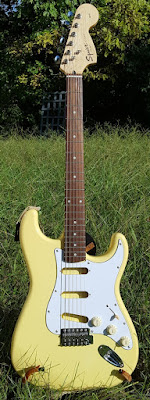
Besides building guitar pedals I put together my first partscaster. Now I say put together as I bought the body and already owned the parts for assembly, so I don't feel saying I built the guitar would be strictly accurate. The yellow strat with the Squier neck I picked up from Goodwill many, many years ago came together rather slowly, as I was worried I would completely screw it up. Without fail I did fail, and while this guitar isn't perfect it is my first partscaster assembly, but that just gives me more reason to tinker and fix what's wrong with this guitar in the future.

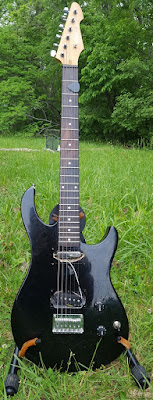
Another sort of build is my Trashcaster, which is just heavy modifications of the Peavey Rockmaster I (also) picked up from Goodwill many years ago. What was a single humbucker guitar with a fairly decent neck, I turned it into a semi-Tele style by installing tele style pickups. I'm pretty sure the Rockmaster body is made of some particleboard or something really cheap because it was crumbling as I was broke ass routing the neck pickup hole. Sure the neck is a bit twisted, but it doesn't affect playability, yet! My ultimate plan is to acquire or build a tele style body and put that neck onto it, and have myself a tele style guitar.

In 2022 I plan to build more pedals, obviously, but I would also like to finish off Trashcaster and finally have a tele style guitar. Another thing I also hope to complete in 2022 is a lap steel guitar, which was on the schedule for this year but I couldn't find the wood to make it happen. With all these plans I know are well within my control there is still one thing that is beyond my control. I just hope that comes back together and these past two years become a mere memory of person growth while getting back on a better track together.

Tuesday, September 14, 2021

Adventures in Guitar Pedal Building: Part 3

I find it amazing how addictive and rewarding it can be to wield a soldering iron and repair or create things, once a person truly gives it a try. For years I used a very old, perhaps antique, soldering iron for repairing or modding video game consoles and was ecstatic when I got it right. That has all led me to building guitar pedals, and I'm beginning to believe I may just have a bit of a problem with this addiction.

For years I had dreamt of owning the pedals, or clones there of, that my guitar heroes use(d). The MXR Distortion Plus for Randy Rhoads, a DOD 250 for Yngwie, a TS808 for almost everyone, a Marshall Guv'nor for Gary Moore, the list goes on and on. What started off as a small mission to build (again perhaps clones there of) these pedals has now led to a different mindset. What if I could build any guitar pedal I've ever wanted, and then some? Well, that may be truer than I ever believed.

Really Cheap Compressor Fail

There are many websites on the internet that offer guitar pedal layouts, with almost endless supplies of guitar pedal layouts to choose from. I'm finding myself dreaming bigger and bigger with each layout that piques my interest. My mindset has now shifted to it's more cost efficient to build than it is to go buy the actual thing. In many cases this is true, but in some rare cases it's not. For example, I recently built a Boss OD-1 clone that I really enjoy. Does it sound exactly the same? I would wager no, but it sounds close enough that I enjoy it. Once the OD-1 was complete I figured I might want to build a DS-1. Who would build a DS-1 when they're so ubiquitous that guitar stores use them to prop open their front door on cool summer days?

The Boss OD-1 isn't even the most recent build, it all started with a Morley MOD-D1B clone that sounds pretty good too. From there I built another EHX LPB-1 but this layout offered a tone control, which is actually quite useful. I built a clone of a JHS little black buffer, just because I had the parts. I built, and failed, at a Really Cheap Compressor pedal. Hey, nobody promised every pedal would be a success, but it is a learning experience. I also built a Fulltone Fat Boost, where I must have used underpowered JFETs, but the basic principle is there so I can change out the offending parts later. And most recently I built both an Effdub Flapjack clone and Danelectro Cool Cat Drive clone, with another pedal remaining to be completed when the clipping diodes arrive.

Top: Boss OD-1 and Fat Boost
Middle: Little Black Buffer
Bottom: Morley MOD-D1B and LPB-1 w/ tone

When I'm not sitting outside soldering together a pedal, or at least contemplating what pedal I want to build next I get very bored. I love sifting through my spare parts and bagging up what the layout requires. Cutting the stripboard to the required size, making the needed cuts and soldering in the jumper links before putting on the real components in order of height. Sure it's a hobby, to some, but I'm so addicted that I've built more pedal circuits than I have housings, footswitches or input/output jacks to complete them. In the meantime I've had to accommodate all these builds by making two test boxes that just require me to solder in the pedal's circuit board and potentiometers to test it. I guess of all the addictions known to humanity building guitar pedals isn't the worst, and maybe someday it will become more than a hobby and start paying for itself.

Test Boxes


Wednesday, May 5, 2021

Adventures in Guitar Pedal Building: Part 2

In part one I had just begun dabbling with building guitar pedals. Since then I've built my TS808 clone, my DOD 250 clone, and I've also fallen out of love with my LPB-1 Boost clone. I did build the board for another boost circuit, but haven't put it into a housing yet. Since all of that I've also built a MXR Distortion Plus as well as a Marshall Guv'nor clone, with my final officially planned build being a compressor pedal.

I've genuinely had a great time building pedals. I've learned a lot about building pedals and how to fix my own mistakes. As time has passed I find myself worrying less about all the little details and just focusing on putting the parts in the right places and getting it all soldered up. I also find myself building pedals with a bit of a theme. You see, some of my favorite guitarists are Randy Rhoads, Gary Moore, Stevie Ray Vaughan and Yngwie Malmsteen. If you look at the pedals I've built you'll see they reflect pedals famously used by those guitarists. Was this intentional? Yes.

So how do I feel about the pedals I've build so far? Well, I still absolutely love my TS808, but I do feel it's really best suited for single coil pickups, as it gets a bit woofy when used with humbuckers. I feel my DOD 250 is a bit noisy, so I may build another board using metal film resistors and preserve my original build. I feel my MXR Distortion Plus is lacking something and is also a bit noisy, so it may also get the metal film resistor treatment. My Marshall Guv'nor build seems pretty good, but I haven't really had much time to use it and become familiar with it. And last, but certainly least, I've fallen out of love with my LPB-1 boost because it thickens up the tone and it just makes everything sound horrible.

As I said earlier my final planned build is a compressor pedal and a few alternative boards to see if they make the pedals sound cleaner, or better. I will preserve the original boards as parts of my progress in the hobby of guitar pedal building. I have tons of parts left over, so I'm sure I'll find something else I want to build and get back to it, but for now I'm satisfied with what I've built, it's just a matter of making it all work together. Heck, I might even build a Wah pedal. Actually, I really might do that.