Tuesday, March 15, 2022

Pedal Building: The Centaur Clone

My guitar pedal building season 2022 started Monday March the 14th. It was a blustery day and the shade of the back deck made it almost unbearable, but I knew I had to get started sometime. My first pedal build was the Klon Centaur clone kit that I had just gotten a few days prior. I put this one ahead of my other builds as I felt time was important. Should there be any parts missing or issues arise with this pedal I would need to contact the seller as soon as possible. At present everything seems to be fine, for the most part.

My workspace on the back deck.

I started off as I always do; lowest components first and work upwards from there. I tested one of each component to make sure they were all labelled correctly. Can't be too careful! Everything was well marked on the main board, with the exception of one of the 100k resistors and the 821pf capacitor being a bit off, but I knew where they went after everything else was soldered up and they were the only parts left and their slightly misaligned places were left empty.

Stage 1

Stage 2

Stage 3

Once the main board was populated it was time to put everything into the housing and do some wiring. Wiring has to be my least favorite part of pedal building, but it has to be done. My distain for wiring was compounded by the fact the provided instructions are extremely vague on what wire goes where. I've wired up enough pedals to know how to wire up the input, output and DC jacks, but where on the board they go is the main mystery here. After doing some research I felt I had a good enough grasp on what went where and I went to work soldering it all up.

Stage 4

The problem is, I was wrong. Even after watching a few videos of people building it from start to finish and reading through some tutorials I still managed to get the output jack wired wrong. Once that was all squared away I had built a really nice pedal. Now, the elephant in the room is that this is a clone of an extremely well known and exceedingly sought after pedal that costs more than a decent used vehicle. That's exactly why I decided this was a project I was more than willing to tackle. I'll never own a real Centaur and even if this pedal doesn't replicate the tone exactly, what this pedal does still sounds pretty good to me. That means it's time for me to start my next project. Stay tuned!


Thursday, February 24, 2022

Pedal Building and 2022's Plans

What started out as a long time desire has grown into twenty confirmed builds. On January 2nd 2020 I put together my very first Bazz Fuss circuit. If you want to get technical about it I did build a footswitch for my Fender Mustang Mini a few years prior, but I don't consider that to be a true pedal build. My main focus was using/reusing parts I already owned or could harvest from electronics nobody wanted. From there I built a handful of other Bazz Fuss circuits, none of which count toward the twenty builds mentioned above. These builds were simply built to play around with values and component types to see how much of a difference it would make in the sound of the circuit.

Fast forward a few months when I noticed my Bazz Fuss pedal was now just boosting the signal, instead of being a fuzz pedal. Somehow I had destroyed the diode and the circuit became a super simple boost pedal. This is where things started to ramp up. Had I stopped at a handful of Bazz Fuss circuits I may have literally just stopped, but I began to research an easy to build boost pedal. Thus, the LPB-1 clones were made. A few weeks later I was given the chance to take apart an old radio my Dad had in the garage and found an NEC 4558 op-amp, and from that my TS808 clone was born. The wheels kept on turning and my Grey DOD 250 clone was born. Soon I felt that since I had built a DOD 250, I had to also build an MXR Distortion Plus, so at the beginning of the 2021 build season that's exactly what I did, but that was only the beginning.

2021 was the most active building year. From my Marshall Guv'nor clone, to many various DOD 250/MXR Distortion Plus clones, such as the Morley MOD-D1B, all the way to a R.O.G. Mockman build I was very busy last year. As 2021 came to a close I had built thirteen pedals with one more left at about 75% complete. It's my most complex pedal build and I hope to complete it as the first pedal completed for 2022.

And here we are in 2022 with a whole new season to build, but also a new year to enjoy the pedals I've built over the past two years. Some pedals have blown me away with how amazing they sound, while a few others continue to baffle me with varying issues. Although the perfectly working pedals heavily outweigh the pedals that exhibit some issues, I still have to troubleshoot the pedals that aren't exactly right. It's a process that I'm greatly enjoying and I'm hoping it leads to something bigger. This year has seven pedals in the planning stage, but it may also turn out to be a transition period for me as I plan to build my first pedal from a kit. I just want to see if I like building kits as much as I do building from scratch. 

Who knows, maybe if I purchase pedal kits and upgrade some of the components in them I might be able to turn this into a viable business of sorts. While I don't foresee that actually coming true, the plan is on the table. We'll just have to see where 2022 leads and what ups and downs I'll have to contend with. Maybe things will work out too well and I'll build more pedals this year than I did in the previous two years combined. For now I'm not sure what will happen beyond 2022, but I do know that I don't plan to build as many pedals, at least for now. However I will always be up for building a pedal here and there just to keep boredom away, or if something really interesting I want to build crosses my path.

Friday, December 31, 2021

My Review of 2021

The past few years have really been hell for us all, well most of us anyway. Due to personal reasons my hell began toward the end of October 2019. I took that as a reason to seek betterment of myself. With the world screeching to a halt a few months later I went one step further and decided this was a time in my life I couldn't pass up the chance to get a few things checked off the old bucket list. It was time to stop pushing the pause button on life and let it playout the way it would playout.

In 2020 I began an adventure in building guitar pedals, as well as selling off things I didn't need anymore to fund a future endeavor. Things went smoothly, given the circumstance, and as Autumn 2020 rolled in I felt it was time to relax and hopefully this whole pandemic would blow over so I could plan my next steps. As we all know that didn't go to plan, so in Spring 2021 I was actually quite antsy to build more guitar pedals, so I did.

I knew there were a few I wanted to build, like my MXR Distortion Plus clone, but I didn't have the drive to build it until the weather felt right to sit out on the back deck and get things done. After a few pedals I felt burnt out and took a break, but as the summer came that urge was put into overdrive (pun absolutely intended!) and more pedals were built. With a few successes and a few absolute failures, and complete rebuilds, the pedal ideas kept coming. For the pedal building season of 2021 I built thirteen pedals; substantially more than I did in 2020. Even as Autumn 2021 came around I was still planning, sourcing parts for, and cutting boards for pedals I plan to build in 2022. I think this year was the year pedal building became a bit more than just a hobby, and perhaps it has reached personal challenge status in my mind.

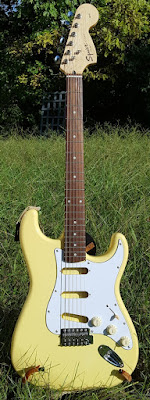
Besides building guitar pedals I put together my first partscaster. Now I say put together as I bought the body and already owned the parts for assembly, so I don't feel saying I built the guitar would be strictly accurate. The yellow strat with the Squier neck I picked up from Goodwill many, many years ago came together rather slowly, as I was worried I would completely screw it up. Without fail I did fail, and while this guitar isn't perfect it is my first partscaster assembly, but that just gives me more reason to tinker and fix what's wrong with this guitar in the future.

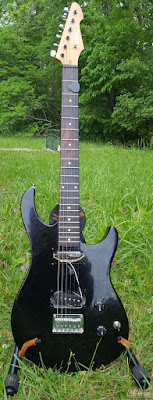
Another sort of build is my Trashcaster, which is just heavy modifications of the Peavey Rockmaster I (also) picked up from Goodwill many years ago. What was a single humbucker guitar with a fairly decent neck, I turned it into a semi-Tele style by installing tele style pickups. I'm pretty sure the Rockmaster body is made of some particleboard or something really cheap because it was crumbling as I was broke ass routing the neck pickup hole. Sure the neck is a bit twisted, but it doesn't affect playability, yet! My ultimate plan is to acquire or build a tele style body and put that neck onto it, and have myself a tele style guitar.

In 2022 I plan to build more pedals, obviously, but I would also like to finish off Trashcaster and finally have a tele style guitar. Another thing I also hope to complete in 2022 is a lap steel guitar, which was on the schedule for this year but I couldn't find the wood to make it happen. With all these plans I know are well within my control there is still one thing that is beyond my control. I just hope that comes back together and these past two years become a mere memory of person growth while getting back on a better track together.

Tuesday, September 14, 2021

Adventures in Guitar Pedal Building: Part 3

I find it amazing how addictive and rewarding it can be to wield a soldering iron and repair or create things, once a person truly gives it a try. For years I used a very old, perhaps antique, soldering iron for repairing or modding video game consoles and was ecstatic when I got it right. That has all led me to building guitar pedals, and I'm beginning to believe I may just have a bit of a problem with this addiction.

For years I had dreamt of owning the pedals, or clones there of, that my guitar heroes use(d). The MXR Distortion Plus for Randy Rhoads, a DOD 250 for Yngwie, a TS808 for almost everyone, a Marshall Guv'nor for Gary Moore, the list goes on and on. What started off as a small mission to build (again perhaps clones there of) these pedals has now led to a different mindset. What if I could build any guitar pedal I've ever wanted, and then some? Well, that may be truer than I ever believed.

Really Cheap Compressor Fail

There are many websites on the internet that offer guitar pedal layouts, with almost endless supplies of guitar pedal layouts to choose from. I'm finding myself dreaming bigger and bigger with each layout that piques my interest. My mindset has now shifted to it's more cost efficient to build than it is to go buy the actual thing. In many cases this is true, but in some rare cases it's not. For example, I recently built a Boss OD-1 clone that I really enjoy. Does it sound exactly the same? I would wager no, but it sounds close enough that I enjoy it. Once the OD-1 was complete I figured I might want to build a DS-1. Who would build a DS-1 when they're so ubiquitous that guitar stores use them to prop open their front door on cool summer days?

The Boss OD-1 isn't even the most recent build, it all started with a Morley MOD-D1B clone that sounds pretty good too. From there I built another EHX LPB-1 but this layout offered a tone control, which is actually quite useful. I built a clone of a JHS little black buffer, just because I had the parts. I built, and failed, at a Really Cheap Compressor pedal. Hey, nobody promised every pedal would be a success, but it is a learning experience. I also built a Fulltone Fat Boost, where I must have used underpowered JFETs, but the basic principle is there so I can change out the offending parts later. And most recently I built both an Effdub Flapjack clone and Danelectro Cool Cat Drive clone, with another pedal remaining to be completed when the clipping diodes arrive.

Top: Boss OD-1 and Fat Boost
Middle: Little Black Buffer
Bottom: Morley MOD-D1B and LPB-1 w/ tone

When I'm not sitting outside soldering together a pedal, or at least contemplating what pedal I want to build next I get very bored. I love sifting through my spare parts and bagging up what the layout requires. Cutting the stripboard to the required size, making the needed cuts and soldering in the jumper links before putting on the real components in order of height. Sure it's a hobby, to some, but I'm so addicted that I've built more pedal circuits than I have housings, footswitches or input/output jacks to complete them. In the meantime I've had to accommodate all these builds by making two test boxes that just require me to solder in the pedal's circuit board and potentiometers to test it. I guess of all the addictions known to humanity building guitar pedals isn't the worst, and maybe someday it will become more than a hobby and start paying for itself.

Test Boxes


Wednesday, May 5, 2021

Adventures in Guitar Pedal Building: Part 2

In part one I had just begun dabbling with building guitar pedals. Since then I've built my TS808 clone, my DOD 250 clone, and I've also fallen out of love with my LPB-1 Boost clone. I did build the board for another boost circuit, but haven't put it into a housing yet. Since all of that I've also built a MXR Distortion Plus as well as a Marshall Guv'nor clone, with my final officially planned build being a compressor pedal.

I've genuinely had a great time building pedals. I've learned a lot about building pedals and how to fix my own mistakes. As time has passed I find myself worrying less about all the little details and just focusing on putting the parts in the right places and getting it all soldered up. I also find myself building pedals with a bit of a theme. You see, some of my favorite guitarists are Randy Rhoads, Gary Moore, Stevie Ray Vaughan and Yngwie Malmsteen. If you look at the pedals I've built you'll see they reflect pedals famously used by those guitarists. Was this intentional? Yes.

So how do I feel about the pedals I've build so far? Well, I still absolutely love my TS808, but I do feel it's really best suited for single coil pickups, as it gets a bit woofy when used with humbuckers. I feel my DOD 250 is a bit noisy, so I may build another board using metal film resistors and preserve my original build. I feel my MXR Distortion Plus is lacking something and is also a bit noisy, so it may also get the metal film resistor treatment. My Marshall Guv'nor build seems pretty good, but I haven't really had much time to use it and become familiar with it. And last, but certainly least, I've fallen out of love with my LPB-1 boost because it thickens up the tone and it just makes everything sound horrible.

As I said earlier my final planned build is a compressor pedal and a few alternative boards to see if they make the pedals sound cleaner, or better. I will preserve the original boards as parts of my progress in the hobby of guitar pedal building. I have tons of parts left over, so I'm sure I'll find something else I want to build and get back to it, but for now I'm satisfied with what I've built, it's just a matter of making it all work together. Heck, I might even build a Wah pedal. Actually, I really might do that.

Saturday, September 12, 2020

The Grey Wasp

 Since I've owned my DOD YJM 308 for so long it began to make me wonder what an original grey DOD 250 sounded like in comparison. Now you can listen to all the youtube videos you want but it's not the same as having them side by side in your personal possession to compare. Since I wouldn't even know where to begin to find one to even borrow I decided I would try my hand at building a clone. I fully understand a clone isn't going to sound exactly like the original, but it should get me somewhere close.

The standard process begins with me looking through layouts online to find one I feel the most comfortable building. Next comes searching for all the parts to put the thing together, followed by cutting down the board and adding the parts, etc. etc. The day came when everything was done. I plugged the pedal in and.. silence. Nothing but pure, low-grade hum and absolutely nothing more. Since the bypass worked I knew it wasn't wired up completely wrong. After checking over it a few times I decided it was best to tear the build all the way back down to the board and test every single component. One at a time.

Since my work station is outside I had a few incidents while testing and rebuilding. First there was a gust of wind that blew some of the parts off the table I work on, losing them forever. Secondly, and this is how the pedal got its name, while doing some soldering I heard a rather loud thud on my table. When I looked up to see what it was, there was a large black wasp with a dead green caterpillar. Omen or miracle? Who knows, but as the original 250 was grey and the clipping on this is rather sharp, like a sting, I figured I would name my build the Grey Wasp.

I have no clue what a real DOD 250 is going to sound like, but after I finally got this thing to work I was rather impressed with how it sounded more or less like the 308. My firm belief is the 308 was focused on helping fans of Yngwie get his tone through a single pedal, instead of being just another 250 pedal clone. If someone really wanted Yngwie's tone they would already own a 250, wouldn't they? Anyhow, since the Grey Wasp does sound fairly similar to the 308, I'll assume that means it sounds fairly close to a grey 250, and I'm ok with that.

The Screaming Pumpkin (TS808 Clone)

What started off as a Bazz Fuss build turned into a pair of LPB-1 clone builds, which has now turned into a TS808 clone build. I had finished the LPB-1 clones maybe a month prior and had no clue what I was going to build next. I still haven't perfected a Bazz Fuss, maybe never will, but I was looking for something new and maybe a bit more challenging to build.

The idea came to me while I was tearing down an old radio and found an NEC c4558c op-amp. I know the 4558 is mostly associated with the Maxon/Ibanez Tube Screamer, so I decided to google NEC c4558c to see whether it was the same or something completely different. Very few google results showed much connection between the NEC op-amp and the TS808, but the few that did yield something seem to indicate some TS808 units do have an NEC 4558 inside of them, and they seem to be fairly rare.

Now that I knew I could build a clone around this op-amp I set to work harvesting the parts from the radio to go around the op-amp. It's just a simple fact that parts degrade with use and time, so I figured if I wanted a vintage TS808 sound I should use the parts this op-amp was already familiar with. I would say I accomplished that for about 90% of the build overall. The other parts I got from other various boards I have laying around.

Gutshot: She isn't pretty.
The layout I used came from Bitsbox.co.uk and their TS808 clone. I used slightly different transistors, so I can't say this is exactly like their kit, but it's probably fairly close. As I was far more comfortable with the Bazz Fuss or LBP-1 layouts I agonized over this build and took my time to make sure I got it right. I took a week carefully looking over boards I have to find the parts I needed to build this pedal, and another week doing things one step at a time to check, recheck, triple check and quadruple check everything to make sure I wasn't going to blow the op-amp once I put it into the sockets.

The day had come, I had finished the board and all that needed done was wiring everything up. I tend to enjoy wiring as I find it the simplest part of the build. The board was all together, the components were all installed inside the housing and all I needed to to was tin connections, tin some wire and solder things together. Even though it's usually a more relaxing experience this build almost broke me. I was so nervous about what could go wrong and trying to troubleshoot so many parts. I pressed on and soldered all the wires to where they needed to go.

I finished soldering up a ground wire for the housing and went to plug the pedal in and see whether it burst into flames or made some tubes scream. At first everything was working perfectly fine, until I engaged the pedal and go no sound at all. I was a bit disappointed, until I remembered that particular power supply has a short near the wall part. After fiddling with the adapter I finally got it to work. I twisted the knobs to see whether I had installed them correctly and the only problem I found was the tone was wired in backwards. Oops. A quick trip to the soldering station and swapping two wires remedied that.

Just to see if it made noise I tested it through my Fender Mustang Mini, but soon graduated to my Kalamazoo. The problem with the Kalamazoo is that it lacks any real tone control, so using the tube screamer sounded muddy with humbuckers. I then decided to test it out on big Bertha and while she is 20+ year old modeling technology the screaming pumpkin did pretty well. Using the good old Marshall models and giving them just enough gain to sound good the screaming pumpkin pushed them even further, even at the lowered drive setting on the pedal.


Friday, August 21, 2020

Rick Sebak Documentaries

Forgive me for sounding a bit cheesy here but I love a good, nay, a feel-good documentary. As a kid we never had cable television so I would, quite often, watch PBS, as there was almost always something interesting to watch. This mentality stayed with me, even after I did have access to cable or satellite television. Among my favorite programs PBS has brought to my attention are: The Red Green Show, Across Indiana (which was probably only aired locally for obvious reasons), History Detectives, Antiques Roadshow, and of course any of the documentaries produced by Rick Sebak.

I can vividly remember having a viral illness in 2004, to the point I felt if I wasn't knocking on death's door it was only because I was too weak to knock. In my illness induced state I was looking for something to watch on television to help get my mind off all the aches and pains, between episodes of being violently ill. It wasn't until I landed on my local PBS that I found something that even remotely caught my interest: A Program About Unusual Buildings and Other Roadside Stuff. As I was still making trips back and forth to the bathroom I couldn't watch it all, but the parts I did catch were very interesting.

Years later I remembered that documentary and decided to try and find it in its entirety. Oddly enough PBS was going to be showing a re-airing of the program later in the week. I waited impatiently each and every day until I could finally watch it completely, without the being violently ill stuff. In its entirety the program kept me entertained, even the bits I had seen previously. At the end of the program I remember PBS doing their donate to get this program on DVD pitch, at least I think it was DVD, but I also believe they were offering more documentaries from Rick Sebak. This brought my my attention the hot dog documentary, the flea market documentary, the amusement park documentary and so many more.

What I believe sets Rick Sebak apart is the flow of the documentaries, his voice and the fun way things are presented and, well.. documented. There is always something to see, the shots never hang too long on something, but it doesn't flash by either. You get a chance to engage your eyes on the subject and study the whole scene while being informed of what's going on.

I've held a short-lived conversation with the man himself over twitter about my belief his documentaries are blu-ray and even Netflix worthy. I understand they are primarily made for his local PBS station, but I do enjoy his documentaries to the point I will occasionally drop a few titles randomly in a conversation. I couldn't do that with a History Channel documentary about storming the beaches at Normandy, but I can about amusement parks, hot dogs, oddly shaped buildings, flea markets, great pies, great bakeries, great breakfasts and tons of other feel-good subjects that are well documented by Rick Sebak.

I know these documentaries have helped me get through rough times in the past. They always feel like something to brighten your day, or put a little sunshine in your rain soaked afternoon. I wish I had access to all of his documentaries but it seems PBS has kept a tight lock on them. There are many others I haven't seen such as the cemetery special. Some can be found online, while others can't. I'm hoping soon to see them popping up, officially, online so that they are all available for everyone to enjoy his work.

The Mooer Black Truck

Ever since I repaired my Kalamazoo Model 1, my brother (who is responsible for my interest in guitars) has been debating buying a tube amp for himself. I'm guessing me having a tube amp is why I'm also his tech/demo guy when he makes a purchase. He first purchased a Carvin V3 mini and, when it actually worked, it sounded ok at best. Given Carvin's history I know they can create good amps, but this particular one just wasn't right at all. After returning that my brother wanted a Spider Valve, then a Marshall DSL, but seemingly out of nowhere be bought a Mooer Black Truck.

I'm familiar with Mooer pedals, but I somehow never heard of the black or red truck units. After my brother brought it to my attention I googled a few demo videos to see what they were all about and how they work. After my brother dropped his off for me to test I plugged it into my Kalamazoo Model 1 to see what this thing was all about. The Mooer black truck offers six effects, not to mention a bright and easy to read tuner, all in one sturdy unit. Reverb, delay, Modulation such as phaser, tremolo and flange, a five band EQ, high gain distortion with a mids scoop and noise gate switch as well as a compressor and overdrive. That's an impressive array of effects all stuffed into this little thing.

After playing around with it I fell in love with the overdrive, which I believe is based off their Green Mile pedal, with a little reverb. The only drawback I see is the lack of control you have over the reverb. The control of the delay is perfect for my style of delay, but I did find the control over the reverb to be quite lacking to achieve what I prefer, but that's just me. Stacking the overdrive and high gain pedals yielded some really interesting tones as well. I'm really impressed with how everything sounds, the ease of use and the fact they managed to put so many features in such a small little unit. You can use presets or make your own. If I wasn't building my own pedals I would probably find myself buying the Red Truck and using only that with my Kalamazoo Model 1 and being perfectly happy.

DIY ABY

Back in 2011 I came across a Johnson J3 footswitch at a local Goodwill for $2. Since I don't own the amps or systems this footswitch works with I originally wanted to repurpose it into an A/B/Y pedal. My problem centered around the fact that the J3 has three switches, and while you could use three for an A/B/Y pedal, two will suffice. The switches that come stock inside the footswitch are momentary so that meant I had to order some 3PDT switches. After fewer switches than I had ordered arrived I decided to only use two. Once everything was said and done I stood back and looked at the project and realized just how horrible it all looked with a gaping hole in the center and packed it away in a box to be forgotten.

Now the year is 2020 and things have moved on quite a bit. Other than wiring the project was done, but I just simply can not get over that hole in the center. Yeah, I hate it too, believe me. I had high hopes for this one, but it's that damn hole in the center. Sure I could plug it up, but I just don't think it would ever look right. So what am I suppose to do now? Well I've already made an A/B pedal. It's not the A/B/Y I wanted, but it's something I built myself, it's functional and it will get me close enough to where I wanted to be, all in an extremely small form factor. Not only did I scrap the original project, this article right here has been in draft form for over three years. Don't believe me? Take a look.

And that's just the last modified date,
not when I originally started.

As I've stated in a previous post I decided 2020 was going to be the year I built my own guitar pedals, long before the world came to a stop all at once. I had ordered an exceedingly cheap 1590a style enclosure that was too small to house the fuzz pedal I originally planned to put in there. After some fiddling I decided to turn it into an A/B pedal. One DPDT footswitch, three jacks and a little wiring and this thing came together rather quickly. Although I'm not exactly happy that one of the outputs comes out the top, it's somehow far more pleasing to me than having an A/B/Y pedal with a hole in the center.


I guess since this post was originally about the A/B/Y pedal I may as well finish up by showing some of the progress photos before I decided to toss it in a box and forget it. Someday I might come up with an idea of what to do with it. Maybe an A/B/Y with a boost or volume control to fill up that center slot.. Hmmmm. Now that I mention it..